PRP Injections for Stubborn Heel Pain and Tendonitis
If rest, stretching, and shoe inserts haven’t fixed your heel or ankle pain, platelet-rich plasma (PRP) may be worth a conversation.
By Dr. Tyler Kelly, DPM, FACFAS
Tri-State Orthopaedics
Persistent foot and ankle pain has a way of shrinking your world. The morning walk to the kitchen hurts, your daily run gets shelved, and even standing through a workday becomes something you brace for.
Two of the most common culprits we see at Tri-State Orthopaedics are tendonitis — including Achilles and peroneal tendonitis — and plantar fasciitis. When these conditions linger for months and standard care isn’t enough, platelet-rich plasma (PRP) injections are one option we may discuss.
First, what are these conditions?
Plantar fasciitis
The plantar fascia is a thick band of tissue running along the bottom of your foot, from heel to toes. When it’s irritated and inflamed, it causes that sharp, stabbing heel pain — classically worst with your first steps in the morning. It’s one of the most common causes of heel pain in adults.
Achilles tendonitis
The Achilles tendon connects your calf muscle to your heel bone. Overuse, tight calves, or a jump in activity can leave it sore, stiff, and swollen — often felt just above the heel and aggravated by walking or running.
Peroneal tendonitis
The peroneal tendons run along the outside of your ankle and help stabilize your foot. When they become inflamed — often after an ankle sprain or repetitive strain — you’ll typically feel pain and swelling on the outer ankle, especially with activity.
The common thread: tendons and the plantar fascia have a limited blood supply, which is part of why they can be slow to heal. PRP is designed to deliver a concentrated dose of your body’s own healing signals right where they’re needed.
What is PRP, exactly?
Platelet-rich plasma is made from your own blood. Platelets are the cells that help you clot and heal, and they carry growth factors that signal tissue to repair itself. The idea behind PRP is simple: concentrate those platelets and place them directly into the injured area to encourage healing.
- Blood draw. We take a small sample of your blood, much like a routine lab draw.
- Spin it down. The sample goes into a centrifuge that separates and concentrates the platelets from the rest of the blood.
- Targeted injection. The concentrated plasma is injected into the painful tendon or fascia, often with ultrasound guidance for accuracy.
The whole visit usually takes under an hour, and because PRP uses your own blood, the risk of an allergic or immune reaction is very low.
Who might be a good candidate?
- You’ve had heel, Achilles, or outer-ankle pain for several months.
- Rest, stretching, physical therapy, supportive shoes, or orthotics haven’t given lasting relief.
- You’d like to explore options before considering surgery.
- You’re generally healthy and able to follow a short recovery and rehab plan.
PRP may not be appropriate for everyone — certain blood conditions, active infections, and some medications can affect candidacy. That’s exactly what an evaluation is for.
What to expect afterward
It’s normal to have some soreness or aching at the injection site for a few days — that mild flare is part of the healing response. Most people are advised to ease off high-impact activity for a short period and then follow a gradual return-to-activity or physical therapy plan. Because PRP works by stimulating your body’s own repair process, improvement is gradual; many patients notice changes over several weeks rather than overnight.
Frequently asked questions
Is the injection painful?
Most patients tolerate it well. You may feel pressure and some discomfort during and shortly after the injection, which typically settles within a few days. We’ll talk through comfort options beforehand.
How many injections will I need?
It varies. Some people do well with a single injection, while others benefit from a short series. We’ll tailor the plan to your response and your condition.
Ready to talk about your heel or ankle pain?
The team at Tri-State Orthopaedics can evaluate your condition and help you decide whether PRP or another treatment is the right next step.
Walk With Us at the 2026 Total Joint Trek
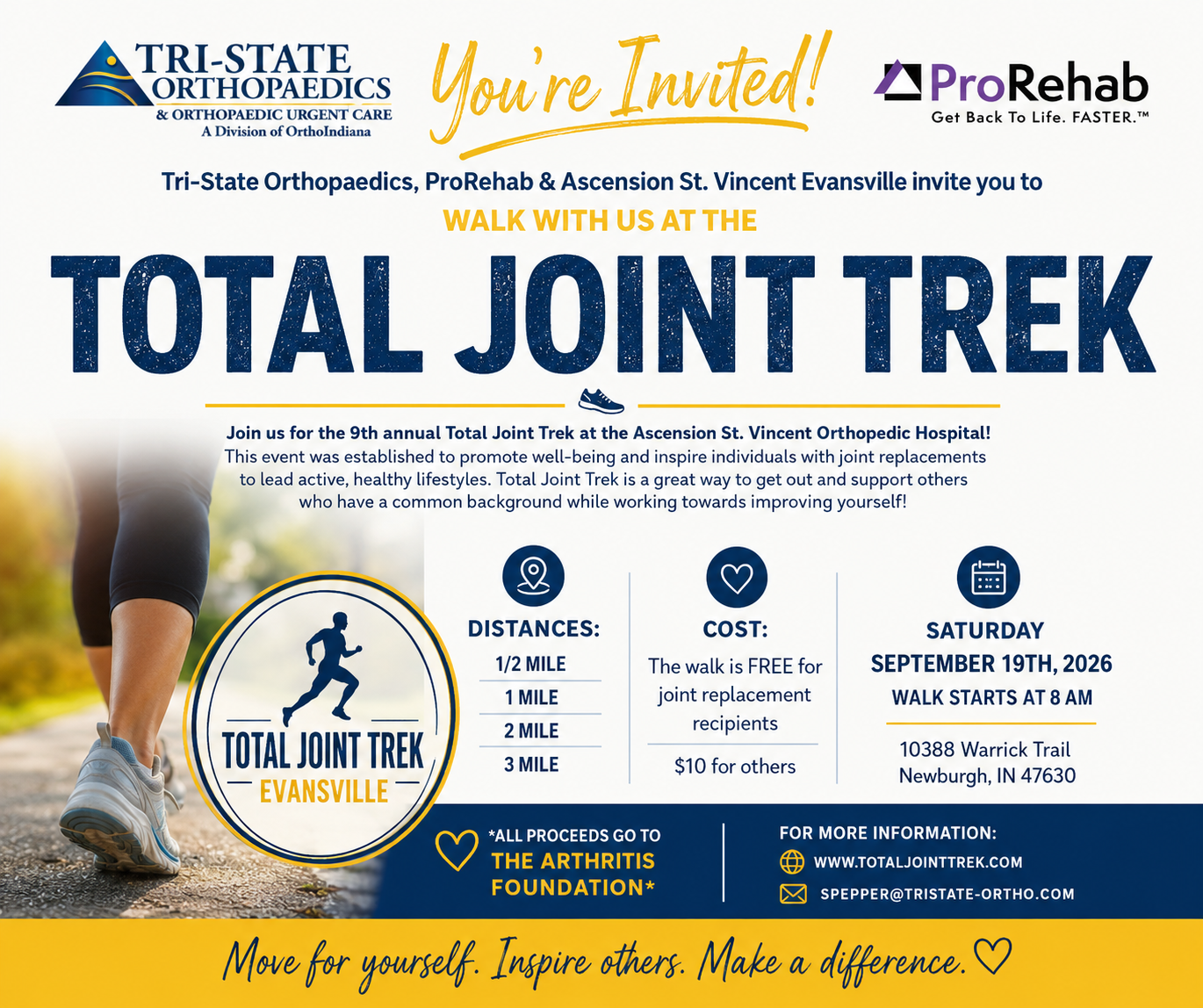
Join Us for the 9th Annual Total Joint Trek
Take a step toward better health and join Tri-State Orthopaedics, ProRehab, and Ascension St. Vincent Evansville for the 9th Annual Total Joint Trek on Saturday, September 19, 2026.
Total Joint Trek brings together joint replacement recipients, their families, friends, caregivers, and community members for a morning of movement, encouragement, and celebration. Whether you’re walking to celebrate your own journey, support a loved one, or simply enjoy time outdoors while giving back, everyone is welcome.
Participants can choose from ½-mile, 1-mile, 2-mile, or 3-mile walking routes, making the event accessible for all activity levels.
Joint replacement recipients walk FREE, while registration for all other participants is $10, with all proceeds benefiting the Arthritis Foundation.
Event Details
- Date: Saturday, September 19, 2026
- Time: Walk begins at 8:00 a.m.
- Location: 10388 Warrick Trail, Newburgh, IN 47630
We look forward to walking alongside you as we celebrate movement, recovery, and healthier living.
Register here.
Moving Forward Together: Tri-State Orthopaedics and OrthoIndiana FAQ
This FAQ answers common questions about Tri-State Orthopaedics partnering with two other practices to form OrthoIndiana and what those changes mean for you as a patient.
Q: Why is Tri-State Orthopaedics becoming part of OrthoIndiana?
A: We are joining with two other practices across Indiana to form a stronger, unified group. This allows us to share resources, expand services, and continue providing high-quality orthopaedic care.
Q: When will this change take place?
A: Our transition date started January 1st.
Q: Will I still see the same doctor and staff?
A: Yes. Your doctor, providers, and care team are not changing. You’ll continue to see the same people at the same locations.
Q: Do I need to change or confirm my appointments?
A: No. All upcoming appointments will remain as scheduled.
Q: How will this affect my bills or insurance claims?
A: Beginning January 1st 2026, bills and insurance claims will appear under the name “Orthopaedics – Indianapolis.”
You may also see this name in places such as:
- Insurance company directories
- Explanation of Benefits (EOBs)
- Patient billing statements
- Insurance websites and portals
Even if the name looks different, your care and service will still come from the same trusted doctors, providers, and staff you know.
Q: Do I need to do anything?
A: No action is required on your part. This transition will happen automatically.
Q: Who can I contact if I have questions?
A: You can call our office at the same phone numbers you’ve always used, and our staff will be happy to help at 812-477-1558.
Q: Why am I receiving bills from two different places?
If you are in the middle of treatment, you will receive separate bills from OrthoIndiana and Tri-State Orthopaedics. All treatments before 1/1/26 will be billed by Tri-State Orthopaedics and bills for Treatment after 1/1/2026 will be from OrthoIndiana.
Q: Why am I being billed when it shows I have a zero balance?
If your treatment was before and after 1/1/2026 and you paid for your services prior to 1/1/2026 you will show a zero balance for Tri-State Orthopaedics but can still owe a balance to OrthoIndiana for your appointments or treatments after 1/1/2026.
Q: What if I have a payment plan?
A: Your existing payment plan will stay as is.
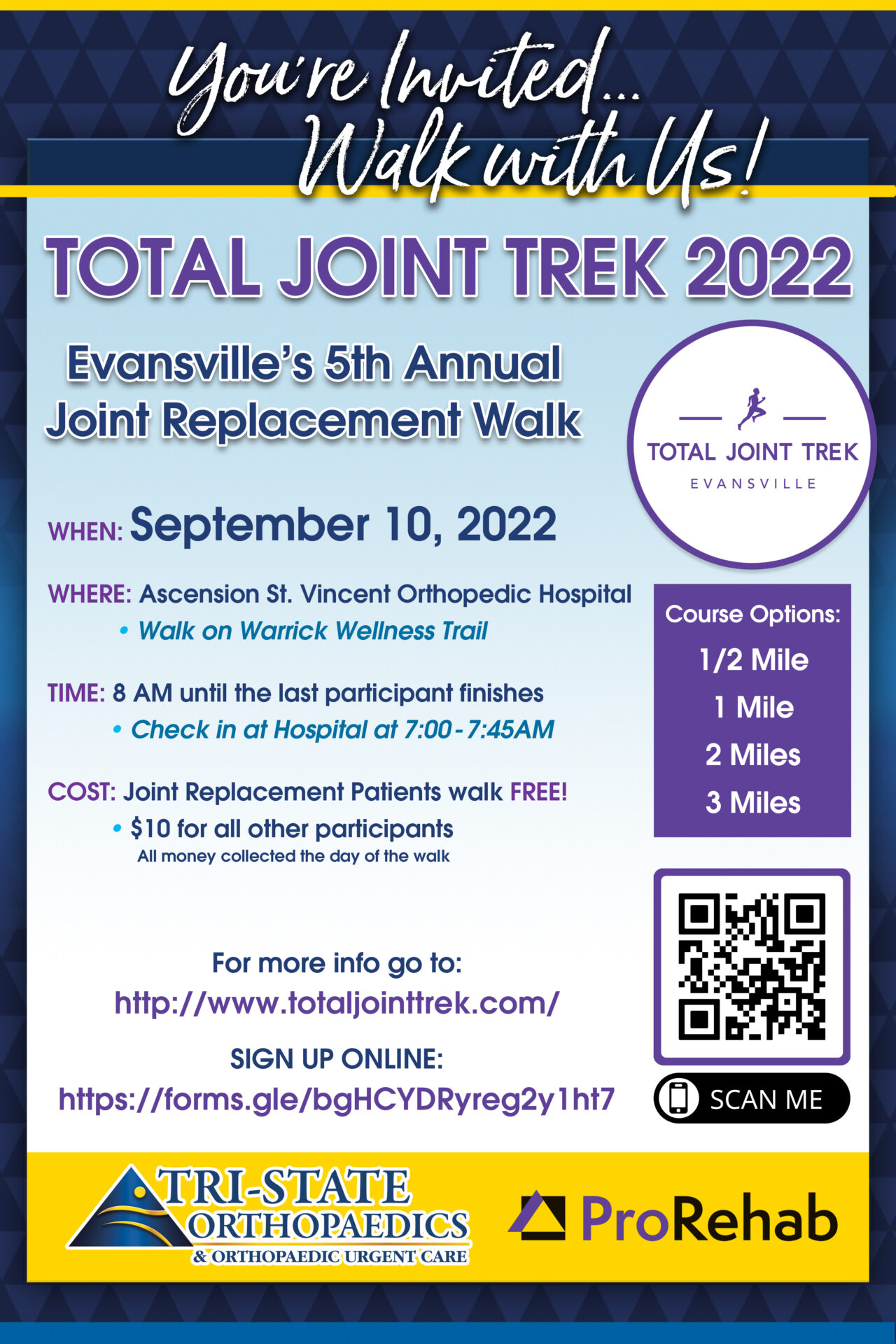
5th Annual Total Joint Trek – September 10th
Our 5th Annual Total Joint Trek is scheduled for Saturday, September 10th starting at 8am. The walk starts from the Ascension St. Vincent Orthopedic Hospital and goes along the Warrick Wellness Trail. There are 4 distances to choose for the walk – 5K (3.1 miles), 2 miles, 1 mile, and 1/2 mile. We have two convenient ways to register – online or print and complete the registration form and drop off at any Tri-State Orthopaedics or ProRehab offices. While fully sponsored by our benefactor, who manages multiple around the world, the walk is FREE for all those that have had a joint replacement and only $10 for all other participants. ALL money will be collected on the day of the race.
Check-in before the walk between 7am -7:45 am in the parking lot in front of the ASTV Orthopedic Hospital.
More information can be found on the Total Joint Trek website.
Tri-State Orthopaedics acquires Quest Orthopedics in Vincennes
Evansville, IN, July 5th Tri-State Orthopaedics is proud to announce the acquisition of Quest Orthopedics and the addition of Terry D. Fenwick, M.D. to our orthopaedic practice effective July 5th. Dr. Fenwick will continue to provide care at 2121 Willow Street in Vincennes location, along with Dr. Nicholas Rensing. We are excited to have them both joining the Tri-State Orthopaedics team.
Dr. Fenwick earned his medical degree from Indiana University School of Medicine in Indianapolis. He completed his residency in orthopaedic surgery at Fort Wayne Medical Education Program. Dr. Fenwick has been an orthopaedic surgeon practicing in Vincennes for 20+ years providing care at Good Samaritan Hospital and Quest Orthopedics. His practice is focused on sports medicine, knee and shoulder arthroscopy, joint replacement, fracture care, and trauma, as well as general orthopaedics.
(more…)
Tri-State Orthopaedics adding a new Orthopaedic Surgeon, Nicholas J. Rensing, M.D.

Evansville, IN, June, 13th Tri-State Orthopaedics is proud to announce the addition of Nicholas J. Rensing, M.D. to our orthopaedic practice. Dr. Rensing will be accepting patients starting the week of July 5th at both our East office – 225 Crosslake Dr, and West office – 5625 Pearl Drive, and our new Vincennes office.
Dr. Rensing earned his medical degree from Indiana University School of Medicine in Indianapolis. He completed his residency in orthopaedic surgery at William Beaumont Army Medical Center/Texas Tech University in El Paso, TX. Dr. Rensing was trained and served in the army for 9 years as a surgeon. He spent time at Ft. Bliss and Ft. Campbell and also did a combat tour in Iraq as part of a forward surgical team. Major Rensing is excited to bring his experience gained in the army to provide orthopedic care to the Tristate area. His practice is focused on sports medicine, knee and shoulder arthroscopy, joint replacement, fracture care, and trauma, as well as general orthopaedics.
(more…)
Painful Diabetic Neuropathy – Free Yourself of Pain
Did you know that over 30 million Americans struggle from diabetes? And from those 30 million, 7.5 million will experience diabetic neuropathy? Diabetic neuropathy deteriorates ones quality of life, and poses a huge financial burden for patient and patient’s caregivers. It causes many complications and can be very painful for the individual. With recent studies, there is hope at the end of the tunnel for those who fight diabetic neuropathy.
What is Diabetic Neuropathy?
Diabetic neuropathy is a type of nerve damage that can occur if you have diabetes. High blood sugar can injure nerves throughout your body. Diabetic neuropathy most often damages nerves in your legs and feet. Depending on the affected nerves, diabetic neuropathy symptoms can range from pain and numbness in your legs and feet to problems with your digestive system, urinary tract, blood vessels and heart. Some people have mild symptoms. But for some, patients might struggle with tingling, burning, stinging type pain. These painful symptoms can interfere with one’s ability to walk or to sleep.
Management
Unfortunately, diabetic neuropathy has to be managed and is never completely cured. It is very important that you work with your doctor to establish a treatment plan to slow the progression of the disease and find ways to relieve the pain.
How to help slow the progression
- Keep your blood sugar within your target range
- Maintain a healthy weight
- Regular physical activity
- Keeping your blood pressure within your target range
Considering these tips to slow the progression of the disease, it is most important to make sure you are working with your physician on a treatment plan that fits you best.
Nevro HFX
For years, conventional medical treatment of Diabetic neuropathy has involved tight blood sugar control, therapy for balance problems, and a small number of medications for the painful symptoms. Unfortunately many patients still struggle with pain and functional limitations despite treatment.
Recently in 2021, a study was published in JAMA Neurology showing that spinal cord stimulation (Nevro HFX) provided relief from painful diabetic neuropathy. 85% of patients received significant pain relief. Spinal cord stimulation has been used for years to treat back pain, and now the FDA has approved it for treatment of painful diabetic neuropathy.
Who to Call
 When you are experiencing some of these symptoms, it is time to call a physician.
- Tingling, burning, or stinging type pain
- Sharp pains for cramps
- Sensitivity to touch (some patients experience pain with even a light bedsheet)
- Numbness or reduced ability to feel pain or temperature changes
Dr. Ryan A. Wetzel has seen diabetic neuropathy in many different patients, and has had great success on keeping them to be pain free. Schedule an appointment with Dr. Wetzel to discuss different treatment options for painful diabetic neuropathy.
Tri-State Orthopaedics’ Newburgh office earns accreditation
 Evansville, IN, October 4, 2021 Tri-State Orthopaedics is pleased to announce their recent award of accreditation for their Newburgh location by the Accreditation Association for Ambulatory Health Care (AAAHC).
This is an important milestone in the continuing growth and success of our health care organization. Pursuing accreditation reflects our dedication and commitment to delivering the highest level of quality care and elevating the overall patient experience. Achieving AAAHC Accreditation demonstrates that Tri-State Orthopaedics has met the rigorous standards of a nationally recognized accreditation organization.
Having earned AAAHC Accreditation, our organization embodies the spirit of 1095 Strong, quality every
day; the three-year or 1,095-day period in the accreditation term, during which we will continue to
practice performance and quality improvement and deliver the best possible patient experience.
Retirement Celebration for Dr. Grimm
Congratulations and Best Wishes to Dr. Grimm on his retirement. Tri-State Orthopaedics has been blessed to have him as a dedicated and caring surgeon to patients for 30 years. He will be greatly missed by our physicians, staff and patients.


Retirement Celebration for Dr. Stiver
Congratulations and Best Wishes to Dr. Stiver on his retirement. Tri-State Orthopaedics has been blessed to have him as a compassionate and dedicated physician and surgeon to patients for over 34 years. He will be greatly missed by our physicians, staff and patients.